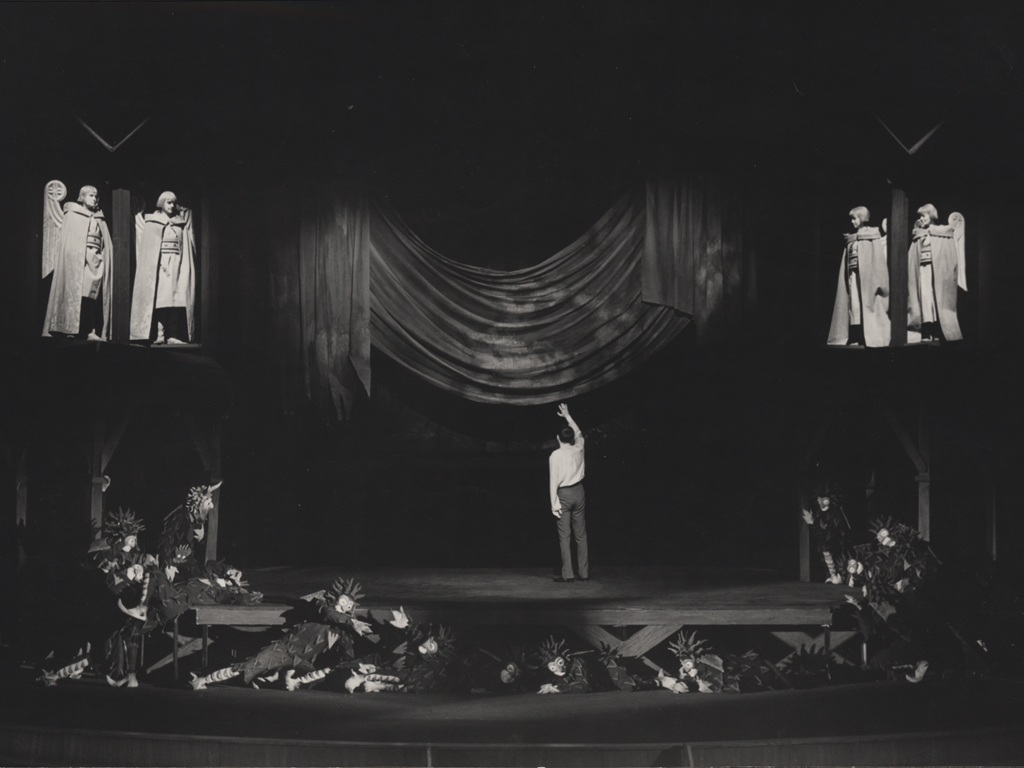
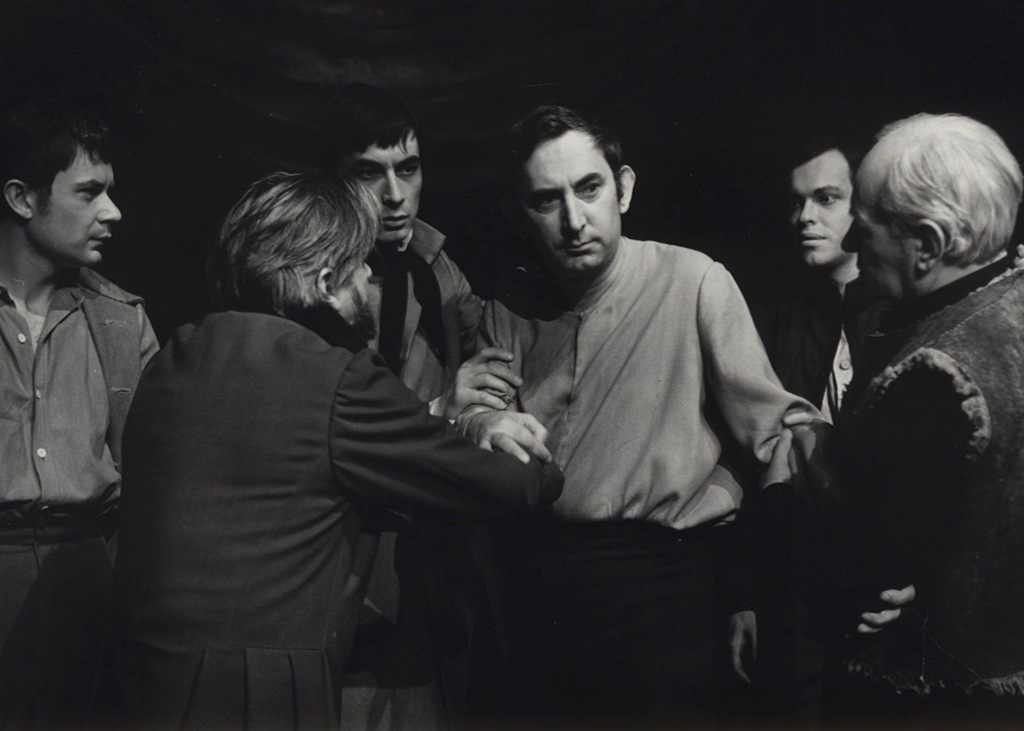
Premiera: 25 listopada 1967
Autor: Adam Mickiewicz
Tytuł: Dziady
Reżyseria:
Kazimierz Dejmek

Dziady

układ tekstu i reżyseria: Kazimierz Dejmek
scenografia: Andrzej Stopka
wybór muzyki: Stefan Sutkowski
opracowanie muzyczne: Jerzy Dobrzański
praca nad słowem: Krystyna Mazur
przygotowanie wokalne: Jerzy Kołaczkowski, Romana Krebsówna, Romuald Miazga
układ tańca: Barbara Fijewska

Obsada (osoby w kolejności ukazywania się na scenie):

Guślarz Kazimierz Opaliński
Aniołki Chór dziecięcy
Widmo Kazimierz Wichniarz
Chór ptaków nocnych Halina Michalska, Joanna Walterówna, Danuta Wodyńska, Aleksandra Zawieruszanka, Aleksander Błaszyk, Władysław Kaczmarski, Zbigniew Kryński, Wilhelm Wichurski
Dziewczyna Elżbieta Borkowska
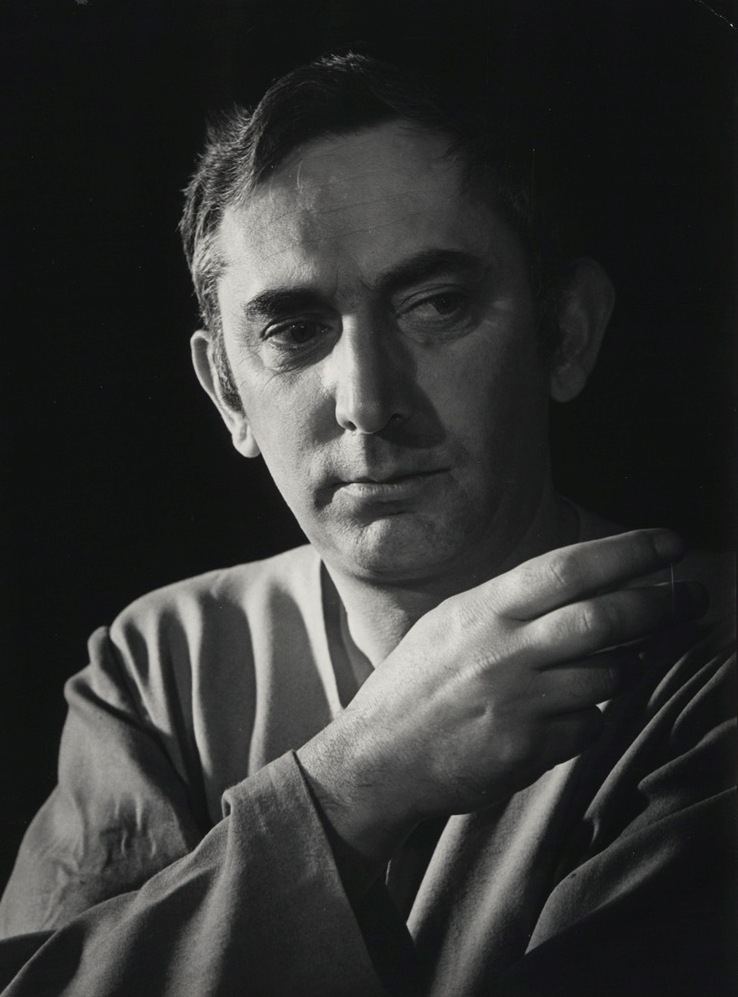
Gustaw-Konrad Gustaw Holoubek
Józef Jan Koecher
Ks. Lwowicz Tadeusz Woźniak
Jankowski Ryszard Nadrowski
Jan Tadeusz Borowski
Suzin Mariusz Leszczyński
Feliks Wojciech Alaborski
Frejend Wojciech Zeidler
Jakub Damian Damięcki
Archaniołowie Mieczysław Kalenik, Andrzej Żarnecki
Aniołowie Danuta Mniewska, Jolanta Russek
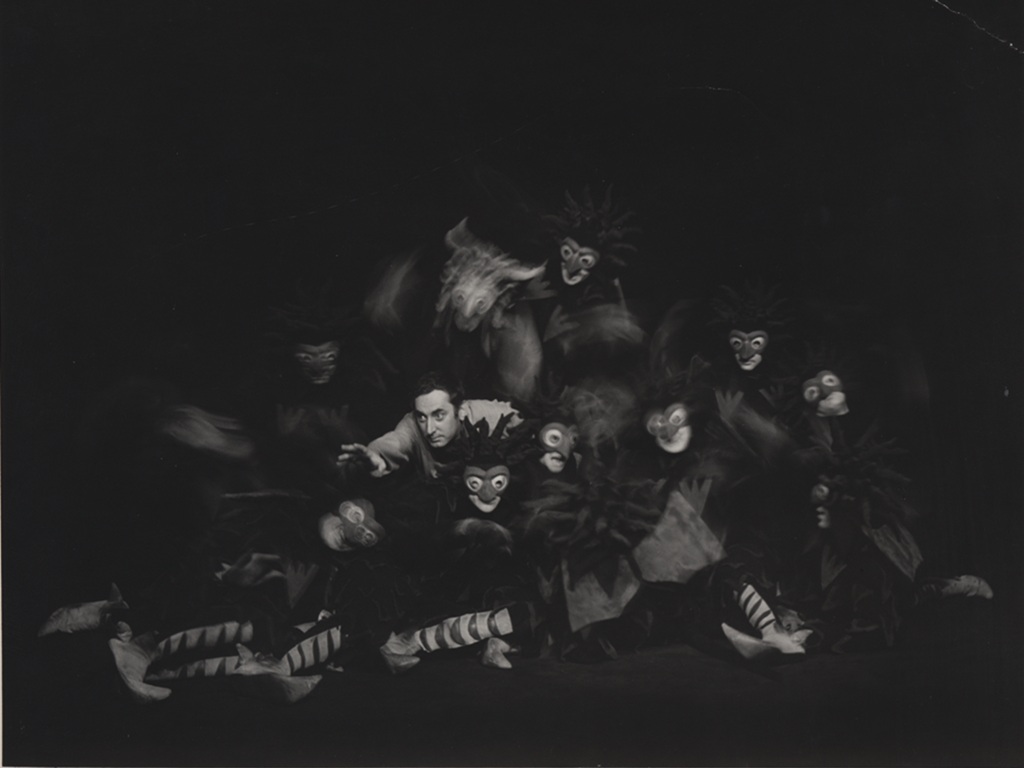
Belzebub Adam Mularczyk
Diabeł I Bogdan Baer
Diabeł II Zdzisław Salaburski
Diabli Wojciech Alaborski, Aleksander Błaszyk, Stefan Brem, Tadeusz Borowski, Damian Damięcki, Michał Gazda, Jerzy Kleyn, Mariusz Leszczyński, Józef Łotysz, Andrzej Madej, Ryszard Nadrowski, Bogdan Szymkowski, Wojciech Zeidler
Ks. Piotr Józef Duriasz
Kapral Zdzisław Szymański
Senator Zdzisław Mrożewski
Niemojewski Michał Gazda
Adolf Stanisław Zaczyk
Jeden z młodzieży Andrzej Madej
Młoda dama Maria Głowacka
Wysocki Józef Łotysz
Hrabiowie Jan Ciecierski, Bogdan Szymkowski
Damy Krystyna Kamieńska, Ewa Krasnodębska, Irena Krasnowiecka
Szambelan Lech Madaliński
Kamerjunkier Aleksander Dzwonkowski
Literaci Henryk Szletyński, Lech Ordon
Doktor Ignacy Machowski
Pelikan Jan Kobuszewski
Sekretarz Zbigniew Kryński
Rollisonowa Barbara Rachwalska (w programie wydrukowano nazwisko Ireny Eichlerówny, ale aktorka zrezygnowała z roli)
Kmitowa Manuela Kiernikówna
Justyn Pol Igor Śmiałowski
Bestużew Aleksander Błaszyk
Starosta Michał Pluciński
Oficer rosyjski Wilhelm Wichurski
Goście na balu Helena Galińska, Wanda Łuczycka, Aniela Rolandowa, Zofia Tymowska, Stefan Brem, Władysław Kaczmarski, Jerzy Klein, Zdzisław Szymański
Panny i młodzieńcy na balu Alicja Bobrowska, Elżbieta Borkowska, Jolanta Russek, Aleksandra Zawieruszanka, Hanna Zembrzuska, Wojciech Alaborski, Tadeusz Borowski, Mariusz Leszczyński, Ryszard Nadrowski, Wojciech Zeidler

oraz

Chór Towarzystwa Śpiewaczego „Harfa” pod kierownictwem Jerzego Kołaczkowskiego i Tadeusza Olszewskiego
Chór dziecięcy pod kierownictwem Romualda Miazgi
dyrygent Jerzy Dobrzański

Realizatorzy:

  • asystentka reżysera: Jitka Stokalska

Galeria:
Bibliografia:

Beylin Karolina, „Dziady”, „Express Wieczorny”, 28.11.1967
(dag), Premiera „Dziadów” w Narodowym. Rozmawiamy z reżyserem spektaklu Kazimierzem Dejmkiem, „Kurier Polski”, 22.11.1967
Filler Witold, Mickiewiczowskie „Dziady” na polskich scenach, rozmawiali G. Lasota i W. Filler, „Życie Warszawy”, 7.02.1967
Grodzicki August, „Dziady w Narodowym, „Życie Warszawy”, 28.11.1967
Janowicz Leon, Misterium ludowe, „Kurier Polski”, 28.11.1967
Jarecki Andrzej, Wielka improwizacja, „Sztandar Młodych”, 30.11.1967
JASZCZ, „Dziady” Kazimierza Dejmka, „Trybuna Ludu”, 28.11.1967
Polanica Stefan, „Dziady w Narodowym, „Słowo Powszechne”, 29.11.1967
Sieradzka Zofia, Nowe inscenizacje arcydzieł naszej dramaturgii, „Głos Pracy”, 30.11.1967

  • THE POLISH THERMOPYLAE / «ПОЛЬСЬКІ ТЕРМОПІЛИ»

    The Polish Thermopylae with surtitles in English and Ukrainian / «ПОЛЬСЬКІ ТЕРМОПІЛИ» демонструється з субтитрами англійською та українською мовами.

  • DRIVE YOUR PLOW OVER THE BONES OF THE DEAD

    As one of the most acclaimed books by Polish Nobel laureate Olga Tokarczuk, directed by Ewa Platt. 

  • MEN EXPLAIN THINGS TO ME

    Klaudia Gębska stages the play based on the most famous collection of essays by Rebecca Solnit. 

  • THE POLISH THERMOPYLAE

    In his first play at the National Theatre, director Jan Klata has opted for Tadeusz Miciński's The Polish Thermopylae

  • INFINITE JEST

    Premiere staged by Kamil Białaszek. His work intersects with a legend of postmodernism, David Foster Wallace. 

  • CHARLATANS

    “When I’m not acting, life is black and white,” says the heroine of Pablo Remón’s play. Charlatans directed by Grzegorz Małecki 

  • HAMLET

    Jan Englert crowns his twenty-eight seasons of artistic work at the National Theatre with a performance of Hamlet.

  • HEAVEN AND HELL

    Although Maria Wojtyszko's play touches upon the painful subject of losing loved ones, Jakub Krofta's deft staging provides light entertainment for the whole family. 

  • OTHER DELIGHTS

    This adaptation of the novel Other Delights is the second staging of one of Jerzy Pilch's works at the National Theatre, following The Holy Father's Skis.  

  • FAUST

    Faust is a story based on an ancient legend of a scholar who yearns so much for just a moment of happiness that he makes a pact with the devil. 

  • A DREAM PLAY

    After the well-received Alice's Adventures in Wonderland, Sławomir Narloch returned to the National Theatre with another premiere – A Dream Play by Strindberg.


  • KING LEAR

    King Lear may be Shakespeare's boldest examination of human nature. Jan Englert will play the title role in the National Theatre's production.

  • WAITING FOR GODOT

    "What do we do now? Wait. [...] We're waiting for Godot". Piotr Cieplak directs Waiting for Godot by Beckett. Is this a classic yet? Does it still have its avant-garde power?

  • FREDRO: THE JUBILEE YEAR

    To celebrate 230 years since Aleksander Fredro's birth, the National Theatre invites you to an evening dedicated to the life and works of Poland’s greatest comedy writer. 

  • TALES FROM THE VIENNA WOODS

    Małgorzata Bogajewska directs for the second time at the National Theatre. This time she draws on Ödön von Horváth's 1931 drama.

  • THE THEATRE MAKER

    The play by Thomas Bernhard, one of the most outstanding playwrights of the second half of the 20th century. In the title role – Jerzy Radziwiłowicz. 

  • ALICE'S WONDERLAND

    Have you ever quarreled with the Time or visited a forest where things have no names? Alice’s Wonderland is a musical performance based on the famous novel by Lewis Carroll. 

  • THE MISANTHROPE

    Jan Englert stages a classic play by Molière. What is Alcest's misanthropy: an uncompromising commitment to the truth or a doomed uprising against social conventions?

  • THE DECALOGUE

    A meditation upon the moral foundations of the present – an iconic work of Polish cinema, rethought thirty-five years after its creation by Krzysztof Kieślowski and Krzysztof Piesiewicz. 

  • MARY STUART

    Grzegorz Wiśniewski returns to the classic drama about human passions interwoven in a ruthless machinery of history and intrigue.

  • MÜNCHHAUSEN FOR ADULTS

    Baron von Münchhausen lived in the 18th century and told incredible stories about himself. Maciej Wojtyszko directs his own play about the famous adventurer and mystifier.

  • Solidarity with Ukraine | Солідарні з Україною

    The ensemble of the National Theatre stands in solidarity with the Ukrainians who are fighting for the independence of their homeland.

  • PICNIC AT HANGING ROCK

    1900. On a hot, stormy day, Mrs Appleyard's boarding school residents go on a picnic near Hanging Rock. The new theatrical version of the Australian prose classics. 

  • SNAKE SKIN

    Artur Urbański directs his own play which main character is Ruth Berlau, one of Bertolt Brecht's closest associates and life companions.

  • AUTUMN SONATA

    A story about the need for love and acceptance, about an inherited emotional coldness, about the psychological costs of creativity. A theatrical version of a film script by Ingmar Bergman. 

  • MOTHER JOAN OF THE ANGELS

    A performance about the need to experience something that surpasses us. In the title role of the prioress – Małgorzata Kożuchowska. 

  • HOW TO BE LOVED

    This is the performance about love and moral responsibility for another person as well as the mechanisms controlling human memory. The dramatisation of the story by Kazimierz Brandys.


  • LUNGS

    Briliant, full of humour and touching love story of a young couple. Breakups and comebacks, passion and sex, the first important decisions and the search for meaning in a complex, modern world.


  • UHLANS

    The Museum of All-Time Polish Uhlans. Exhibits of the national exacerbation. A serious comedy in three acts about the entanglement in myths of Polishness. 


  • THE IMAGE MAKERS

    The truth about the essence of creation and responsibility in art. Director Viktor Sjöström is working on the film The Phantom Carriage, based on the novel by Nobel Prize winner Selma Lagerlöf. 

  • FOREFATHER'S EVE

    Mickiewicz's poetic drama interpreted by Lithuanian Master Eimuntas Nekrošius — theatre visionary known for his unique theatrical language.


  • KORDIAN

    The Polish nation's tragic choice: to die heroically in the name of a noble idea or live a life "making shoes for dogs"? — the alternative presented to Kordian in two parables.

  • FLEA THE SWINDLER

    Tremendous fun and great laughs – not just for kids. The antics of the Flea are directed by Anna Seniuk with the music composed by Maciej Małecki.